
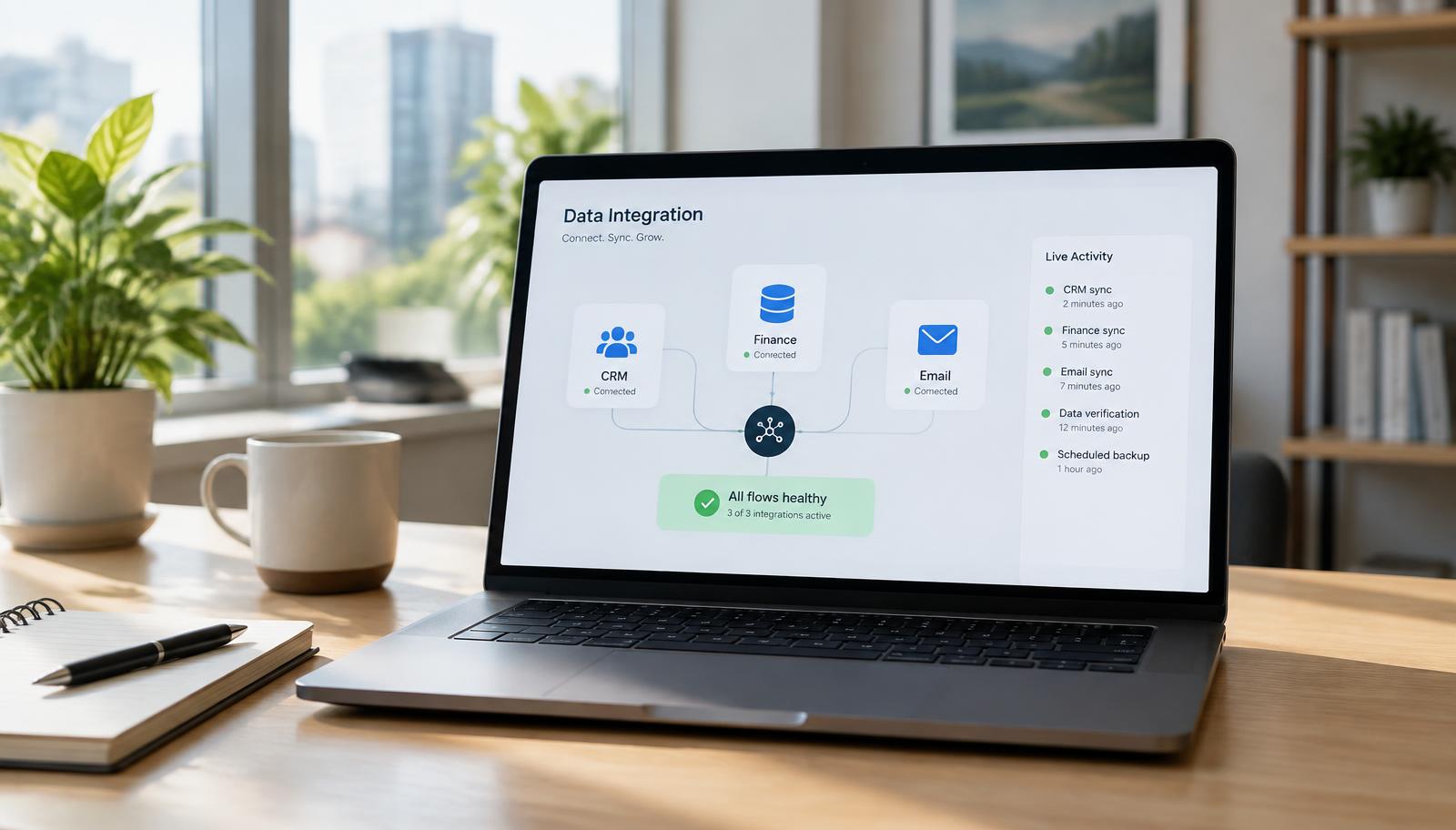
When a client calls or a new instruction lands, whoever picks it up needs an accurate picture straight away: who the client is, what stage the matter has reached, what has been billed and what is still outstanding. If that picture is split across three separate systems, the answer takes ten minutes instead of ten seconds — and sometimes it is wrong.
That is the everyday reality for a lot of Bolton firms. Growth happens one tool at a time. A practice management system goes in, a CRM gets added for business development, accounts stay where they have always been, and nobody ever builds the bridge between them. The bridge ends up being people: someone copies new client details across on a Monday, someone else exports a list every Friday, and a third person keeps a private spreadsheet because they do not fully trust either system.
Where integration changes the day-to-day
A proper integration fixes the cause rather than the symptom. When a matter is opened, progressed or closed, the change flows to every system that needs to know about it. Billing records raise themselves from completed work instead of waiting for someone to reconcile two reports. Management information comes from one source, so a partner asking "how much work in progress do we have?" gets the same answer whoever they ask.
The saving is rarely dramatic in any single week. It is ten minutes here, twenty minutes there, and one avoided mistake a month that would otherwise have taken an afternoon to unpick. Added up across a team, that is a meaningful amount of chargeable time being spent on admin rather than on clients.
What we connect for Bolton firms
Practice management and CRM systems
We connect practice and case management platforms such as Proclaim, Clio, LEAP and Practice Evolve, along with CRMs like Salesforce, HubSpot, Microsoft Dynamics and Pipedrive, to the rest of your operational workflow. A new enquiry becomes a client record, a matter and a billing entry without anyone retyping a postcode.
Finance and billing
Time recorded, disbursements incurred and completed milestones flow into Xero, Sage, QuickBooks, NetSuite or a bespoke ledger. Invoices go out on time, payment status comes back the other way, and the fee earner can see it without opening the accounts system at all.
Client onboarding and document handling
Identity checks, engagement details and signed documents move straight from your intake process into the central file. Compliance records stay complete because the system captures them rather than relying on someone remembering to attach a PDF.
Migrations and two-way sync
Moving to new software is rarely as tidy as the sales demo suggests. We map every field, rehearse the cutover against copies of your real data, and agree what happens when two systems change the same record at once. Then we switch you over without the practice stopping.
How a project runs
Every project starts with discovery. We spend focused time with the people doing the manual work today, watching what they actually do rather than what the process document says. That conversation almost always surfaces two or three exceptions that would have quietly broken the integration in month two — far better to find them in week one.
From there we agree the data mapping, the error handling and the conflict rules, and give you a fixed price. We build and rehearse against copies of your real data, then go live with monitoring switched on from the first record. After that, ongoing support keeps everything healthy as vendors push updates and APIs change.
Security and UK GDPR
Integrations move confidential client and financial information, so security is a design requirement. Every connection uses least-privilege credentials, encrypted transfer and audit logging, and all data stays inside the UK or EU on infrastructure we control. There are no offshore transfers to explain at your next review, and the integration sits comfortably alongside Cyber Essentials expectations rather than complicating them.
If you already have an IT provider looking after devices, networks and email, we work alongside them. We agree who owns which credentials, document what connects to what, and hand over something auditable rather than another mystery box.
Talk to us
If your service delivery is being slowed by systems that do not talk to each other, tell us what you are trying to achieve through the contact form. We will come back within one working day with an honest view of the size of the job and what it would take to fix. You can also read about our integration work in Salford or our custom software development.